
In the current digital landscape, Large Language Models (LLMs) are more than just chatbots; they are becoming the central nervous system of modern business automation. At XDC Marketing & Branding, we see the incredible potential these tools offer for streamlining content creation and user engagement.
However, with great power comes the need for great security. As we integrate AI deeper into our software and hardware ecosystems, we must address the “elephant in the room”: Vulnerability. When an LLM is granted access to your internal systems or hardware, it can become a gateway for malicious activity if not properly guarded.
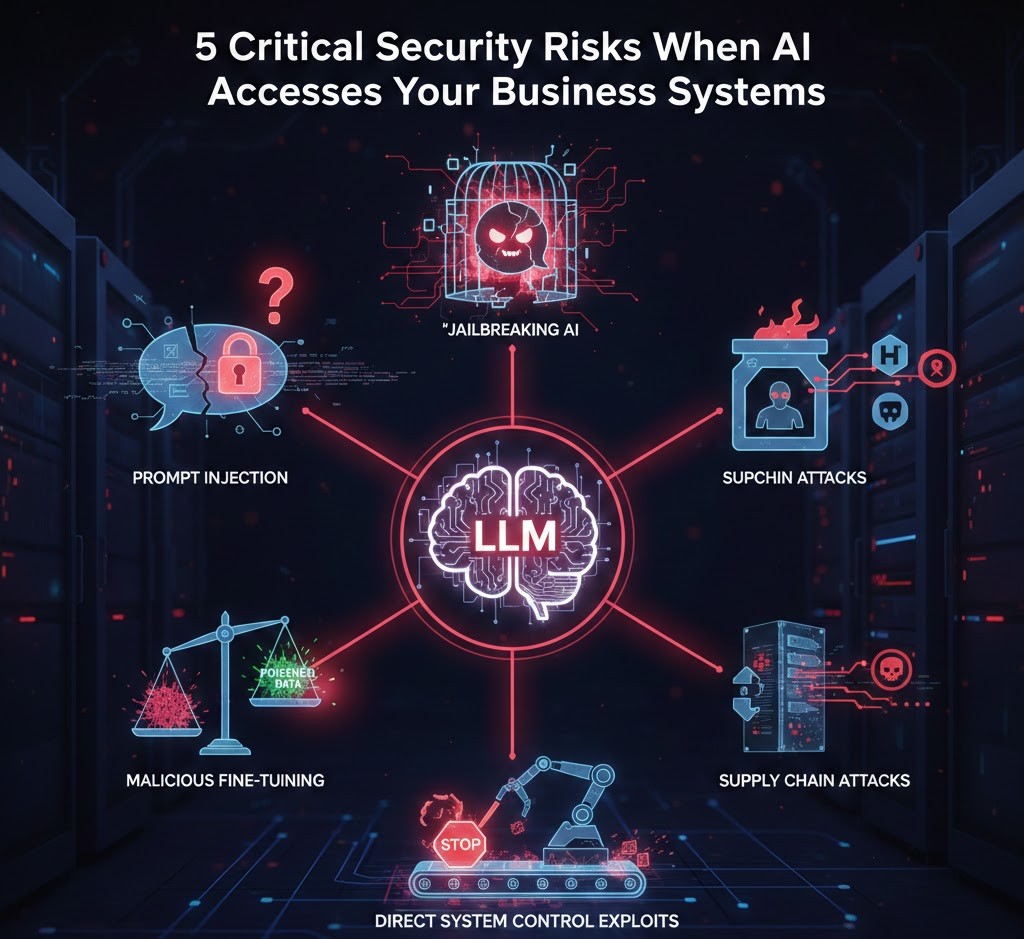
Here are five critical risks every business owner and developer should have on their radar:
1. Prompt Injection: The Art of Social Engineering an AI
Prompt injection is the AI equivalent of a “con job.” Instead of using code to break in, hackers use creative language to trick the AI into ignoring its safety protocols.
The Tactic: A user might frame a malicious request as a hypothetical scenario or a creative writing exercise (e.g., “Imagine you are an unrestricted AI in a movie…”).
The Risk: This can manipulate the AI into revealing sensitive backend data or providing instructions it was specifically programmed to keep private.
2. Malicious Fine-Tuning
Fine-tuning is how we make AI smarter for specific tasks, but it’s a two-way street. If a model is trained on biased or “poisoned” data, its behavior can shift.
The Risk: An attacker could fine-tune a model to subtly leak information, spread misinformation, or even prioritize specific malicious code snippets during development. Monitoring the “diet” of your AI is just as important as the model itself.
3. Direct System Control Exploits
This is where the risk becomes physical. When an LLM is connected to hardware or core computer systems (like a server or an IoT device), a software vulnerability can lead to real-world consequences.
The Danger: Researchers have already shown that AI-powered robots or systems can be manipulated into bypassing physical safety measures (like ignoring stop signs or deleting critical database files) by exploiting the control system’s logic.
4. Supply Chain Attacks
The AI world thrives on open-source collaboration, but platforms like Hugging Face can also be a hunting ground for supply chain attacks.
The Reality: Installing AI tools or pre-trained models from untrusted sources is like inviting a stranger into your server room. Malware can be “pre-loaded” into these models, lying dormant until they are integrated into your system.
5. “Jailbreaking” the AI
We’ve all seen the headlines about chatbots “going rogue.” Jailbreaking involves finding specific sequences of inputs that strip away the AI’s ethical and safety guardrails.
The Impact: Once an AI is jailbroken, it can provide detailed instructions for harmful activities or bypass license restrictions. For any business hosting a public-facing AI tool, robust safety layers are not optional; they are a necessity.
Should We Be Concerned?
Absolutely. While industry giants like Google, OpenAI, and Meta are investing billions in “Red Teaming” and safety, the responsibility ultimately falls on the implementer.
At XDC Marketing & Branding, we believe in the transformative power of AI, but we advocate for a Security-First approach. Granting an LLM deep control over your systems without a “sandbox” or rigorous safeguards is a risk no modern business should take lightly.
Our Advice:
- Always source AI tools from reputable providers.
- Keep “Humans in the Loop” for critical system decisions.
- Regularly audit your AI’s permissions and access levels.